containers,inside std::deque
继续 container ~ 来到 inlcude/bits/stl_deque.h 假设我们对 deque 的内存布局一无所知,然后来看代码看看能不能看出蛛丝马迹。
  /**
   * @brief This function controls the size of memory nodes.
   * @param __size The size of an element.
   * @return The number (not byte size) of elements per node.
   *
   * This function started off as a compiler kludge from SGI, but
   * seems to be a useful wrapper around a repeated constant
   * expression. The @b 512 is tunable (and no other code needs to
   * change), but no investigation has been done since inheriting the
   * SGI code. Touch _GLIBCXX_DEQUE_BUF_SIZE only if you know what
   * you are doing, however: changing it breaks the binary
   * compatibility!!
  */
#ifndef _GLIBCXX_DEQUE_BUF_SIZE
#define _GLIBCXX_DEQUE_BUF_SIZE 512
#endif
  inline size_t
  __deque_buf_size(size_t __size)
  { return (__size < _GLIBCXX_DEQUE_BUF_SIZE
            ? size_t(_GLIBCXX_DEQUE_BUF_SIZE / __size) : size_t(1)); }
默认情况下一个 node 是 512 byte。 deque 是由多个 node 组成的?
继续往下看,是 deque iterator。
  /**
   * @brief A deque::iterator.
   *
   * Quite a bit of intelligence here. Much of the functionality of
   * deque is actually passed off to this class. A deque holds two
   * of these internally, marking its valid range. Access to
   * elements is done as offsets of either of those two, relying on
   * operator overloading in this class.
   *
   * All the functions are op overloads except for _M_set_node.
  */
  template<typename _Tp, typename _Ref, typename _Ptr>
    struct _Deque_iterator
很奇怪的是,这里要三个模板参数。
      typedef _Deque_iterator<_Tp, _Tp&, _Tp*> iterator;
      typedef _Deque_iterator<_Tp, const _Tp&, const _Tp*> const_iterator;
      static size_t _S_buffer_size() _GLIBCXX_NOEXCEPT
      { return __deque_buf_size(sizeof(_Tp)); }
      typedef std::random_access_iterator_tag iterator_category;
      typedef _Tp value_type;
      typedef _Ptr pointer;
      typedef _Ref reference;
      typedef size_t size_type;
      typedef ptrdiff_t difference_type;
      typedef _Tp** _Map_pointer;
      typedef _Deque_iterator _Self;
pointer 和 reference 是用模板参数来定义的,哦,可能外面是吧 deque 的 allocator 拿出来的 pointer 类型再给 iterator 可能是酱紫。ps, _S_buffer_size 可以加一个 constexpr。还有一个 _Map_pointer 不知道做什么的。
      _Tp* _M_cur;
      _Tp* _M_first;
      _Tp* _M_last;
      _Map_pointer _M_node;
_M_node 是 node 的指针,联想一下,deque 应该是由多块连续的内存区域组成(_Tp array),还有一个 _Tp* array 里面每个元素分别指向这些块,然后这个 _M_node 在这块区域上滑动表示当前位置。_M_cur 则是某个具体 _Tp array 上的位置。当然,到目前位置,这些都是 yy。
      _Deque_iterator(_Tp* __x, _Map_pointer __y) _GLIBCXX_NOEXCEPT
      : _M_cur(__x), _M_first(*__y),
        _M_last(*__y + _S_buffer_size()), _M_node(__y) { }
      _Deque_iterator() _GLIBCXX_NOEXCEPT
      : _M_cur(0), _M_first(0), _M_last(0), _M_node(0) { }
      _Deque_iterator(const iterator& __x) _GLIBCXX_NOEXCEPT
      : _M_cur(__x._M_cur), _M_first(__x._M_first),
        _M_last(__x._M_last), _M_node(__x._M_node) { }
构造没啥好看的,继续往下,又是各种 operator。哦还有之前遇到过的 _M_const_cast。
      iterator
      _M_const_cast() const _GLIBCXX_NOEXCEPT
      { return iterator(_M_cur, _M_node); }
重点来了
      _Self&
      operator++() _GLIBCXX_NOEXCEPT
      {
        ++_M_cur;
        if (_M_cur == _M_last)
          {
            _M_set_node(_M_node + 1);
            _M_cur = _M_first;
          }
        return *this;
      }
      _Self
      operator++(int) _GLIBCXX_NOEXCEPT
      {
        _Self __tmp = *this;
        ++*this;
        return __tmp;
      }
看来大概是之前 yy 的那个原理。如果到这个 node 的末尾了,就换到下一个 node,然后 cur 放到这个 node 的起始。 _M_first 是一段 _Tp 元素的第一个, _M_last 是一段 _Tp 元素最后一个的位置 + 1(也就是无效的那个位置,其实应该命名为 end)。
      /**
       * Prepares to traverse new_node. Sets everything except
       * _M_cur, which should therefore be set by the caller
       * immediately afterwards, based on _M_first and _M_last.
       */
      void
      _M_set_node(_Map_pointer __new_node) _GLIBCXX_NOEXCEPT
      {
        _M_node = __new_node;
        _M_first = *__new_node;
        _M_last = _M_first + difference_type(_S_buffer_size());
      }
不过这里有一个问题,如果 _M_set_node 到头了呢?这里并没有做处理,难道是在外面。
      _Self&
      operator--() _GLIBCXX_NOEXCEPT
      {
        if (_M_cur == _M_first)
          {
            _M_set_node(_M_node - 1);
            _M_cur = _M_last;
          }
        --_M_cur;
        return *this;
      }
      _Self
      operator--(int) _GLIBCXX_NOEXCEPT
      {
        _Self __tmp = *this;
        --*this;
        return __tmp;
      }
operator– 也是,万一到了尽头?
      _Self&
      operator+=(difference_type __n) _GLIBCXX_NOEXCEPT
      {
        const difference_type __offset = __n + (_M_cur - _M_first);
        if (__offset >= 0 && __offset < difference_type(_S_buffer_size()))
          _M_cur += __n;
        else
          {
            const difference_type __node_offset =
              __offset > 0 ? __offset / difference_type(_S_buffer_size())
                           : -difference_type((-__offset - 1)
                                              / _S_buffer_size()) - 1;
            _M_set_node(_M_node + __node_offset);
            _M_cur = _M_first + (__offset - __node_offset
                                 * difference_type(_S_buffer_size()));
          }
        return *this;
      }
      _Self
      operator+(difference_type __n) const _GLIBCXX_NOEXCEPT
      {
        _Self __tmp = *this;
        return __tmp += __n;
      }
如果 += __n 不超过这个 buf,则直接前移,如果超过了,就除一下看有多少个。这段代码写的非常简洁~
            const difference_type __node_offset =
              __offset > 0 ? __offset / difference_type(_S_buffer_size())
                           : -difference_type((-__offset - 1)
                                              / _S_buffer_size()) - 1;
            _M_set_node(_M_node + __node_offset);
            _M_cur = _M_first + (__offset - __node_offset
                                 * difference_type(_S_buffer_size()));
注意这句喔 -difference_type((-__offset - 1) / _S_buffer_size()) - 1; 后面的 operator+ operator- operator-= 都是根据之前的 operator 定义的~。就不一一说明
后面还有各种比较 operator,还有 + - 什么的
  template<typename _Tp, typename _Ref, typename _Ptr>
    inline typename _Deque_iterator<_Tp, _Ref, _Ptr>::difference_type
    operator-(const _Deque_iterator<_Tp, _Ref, _Ptr>& __x,
              const _Deque_iterator<_Tp, _Ref, _Ptr>& __y) _GLIBCXX_NOEXCEPT
    {
      return typename _Deque_iterator<_Tp, _Ref, _Ptr>::difference_type
        (_Deque_iterator<_Tp, _Ref, _Ptr>::_S_buffer_size())
        * (__x._M_node - __y._M_node - 1) + (__x._M_cur - __x._M_first)
        + (__y._M_last - __y._M_cur);
    }
  template<typename _Tp, typename _RefL, typename _PtrL,
           typename _RefR, typename _PtrR>
    inline typename _Deque_iterator<_Tp, _RefL, _PtrL>::difference_type
    operator-(const _Deque_iterator<_Tp, _RefL, _PtrL>& __x,
              const _Deque_iterator<_Tp, _RefR, _PtrR>& __y) _GLIBCXX_NOEXCEPT
    {
      return typename _Deque_iterator<_Tp, _RefL, _PtrL>::difference_type
        (_Deque_iterator<_Tp, _RefL, _PtrL>::_S_buffer_size())
        * (__x._M_node - __y._M_node - 1) + (__x._M_cur - __x._M_first)
        + (__y._M_last - __y._M_cur);
    }
  template<typename _Tp, typename _Ref, typename _Ptr>
    inline _Deque_iterator<_Tp, _Ref, _Ptr>
    operator+(ptrdiff_t __n, const _Deque_iterator<_Tp, _Ref, _Ptr>& __x)
    _GLIBCXX_NOEXCEPT
    { return __x + __n; }
都是一眼都能看懂的~
注意到下面还有一堆的 copy, fill ,copy_backward, move, move_backward 的重载。暂且不看,具体的实现都在 deque.tcc 里面。
接下来是 _Deque_base,目测和 _Vector_base 一个套路,只负责内存的分配。
    class _Deque_base
    {
    public:
      typedef _Alloc allocator_type;
      allocator_type
      get_allocator() const _GLIBCXX_NOEXCEPT
      { return allocator_type(_M_get_Tp_allocator()); }
      typedef _Deque_iterator<_Tp, _Tp&, _Tp*> iterator;
      typedef _Deque_iterator<_Tp, const _Tp&, const _Tp*> const_iterator;
      _Deque_base()
      : _M_impl()
      { _M_initialize_map(0); }
      _Deque_base(size_t __num_elements)
      : _M_impl()
      { _M_initialize_map(__num_elements); }
      _Deque_base(const allocator_type& __a, size_t __num_elements)
      : _M_impl(__a)
      { _M_initialize_map(__num_elements); }
      _Deque_base(const allocator_type& __a)
      : _M_impl(__a)
      { }
#if __cplusplus >= 201103L
      _Deque_base(_Deque_base&& __x)
      : _M_impl(std::move(__x._M_get_Tp_allocator()))
      {
        _M_initialize_map(0);
        if (__x._M_impl._M_map)
          {
            std::swap(this->_M_impl._M_start, __x._M_impl._M_start);
            std::swap(this->_M_impl._M_finish, __x._M_impl._M_finish);
            std::swap(this->_M_impl._M_map, __x._M_impl._M_map);
            std::swap(this->_M_impl._M_map_size, __x._M_impl._M_map_size);
          }
      }
#endif
这里还是用了一个 _M_impl 成员,目测又继承了 allocator。_M_impl 里面有几个关键的成员,_M_start, _M_finish, _M_map, M_map_size。
      struct _Deque_impl
      : public _Tp_alloc_type
      {
        _Tp** _M_map;
        size_t _M_map_size;
        iterator _M_start;
        iterator _M_finish;
_M_map 应该就是那段储存各个 node 地址的地方,_M_start, _M_finish 应该分别是 deque 的 start 和 finish。
    protected:
      typedef typename _Alloc::template rebind<_Tp*>::other _Map_alloc_type;
      typedef typename _Alloc::template rebind<_Tp>::other _Tp_alloc_type;
在 _Deque_impl 中,为了分配 map,要得到一个 rebind 到 _Tp* 的 allocator。
来看 _M_initialize_map, _M_map 是怎么做初始化的。
  template<typename _Tp, typename _Alloc>
    void
    _Deque_base<_Tp, _Alloc>::
    _M_initialize_map(size_t __num_elements)
    {
      const size_t __num_nodes = (__num_elements/ __deque_buf_size(sizeof(_Tp))
                                  + 1);
      this->_M_impl._M_map_size = std::max((size_t) _S_initial_map_size,
                                           size_t(__num_nodes + 2));
      this->_M_impl._M_map = _M_allocate_map(this->_M_impl._M_map_size);
      // For "small" maps (needing less than _M_map_size nodes), allocation
      // starts in the middle elements and grows outwards. So nstart may be
      // the beginning of _M_map, but for small maps it may be as far in as
      // _M_map+3.
      _Tp** __nstart = (this->_M_impl._M_map
                        + (this->_M_impl._M_map_size - __num_nodes) / 2);
      _Tp** __nfinish = __nstart + __num_nodes;
      __try
        { _M_create_nodes(__nstart, __nfinish); }
      __catch(...)
        {
          _M_deallocate_map(this->_M_impl._M_map, this->_M_impl._M_map_size);
          this->_M_impl._M_map = 0;
          this->_M_impl._M_map_size = 0;
          __throw_exception_again;
        }
      this->_M_impl._M_start._M_set_node(__nstart);
      this->_M_impl._M_finish._M_set_node(__nfinish - 1);
      this->_M_impl._M_start._M_cur = _M_impl._M_start._M_first;
      this->_M_impl._M_finish._M_cur = (this->_M_impl._M_finish._M_first
                                        + __num_elements
                                        % __deque_buf_size(sizeof(_Tp)));
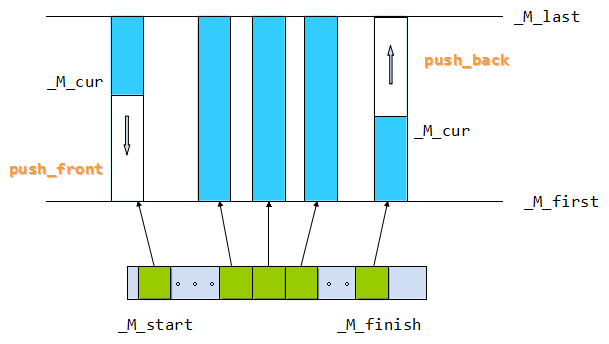
如果传进来的是 0 的话,则 _M_map_size 就是 enum { _S_initial_map_size = 8 }; ,__nstart 被设成 中间的那个 node,__nfinish 则是 (M_map_size + __num_nodes) / 2 的位置(根据之前的 max 这个位置肯定是有效的)。接着在这个范围上 create nodes。如果成功的话,_M_start 就会被 set 成这个 __nstart,而 __M_finish 则会被 set 成 __nfinish - 1(注意 __nfinish - __nstart == __num_nodes)。现在 __M_start 和 _M_finish 之间有 __deque_buf_size * (__num_nodes - 1) 个元素,而 __num_nodes = (__num_elements/ __deque_buf_size+ 1);。如果现在把 _M_start._M_cur 设成 _M_start._M_first ,向后推 __num_elements 得到 _M_finish 所在的 node,再加上 __num_elements % __deque_buf_size,就是 _M_finish._M_cur 应该所在的位置~~~ 这就这段代码的含义。
来一张 deque 的直观图吧~。
顺便过一下 allocate 和 deallocate,不过大概都 yy 的到~~
      _Tp**
      _M_allocate_map(size_t __n)
      { return _M_get_map_allocator().allocate(__n); }
      void
      _M_deallocate_map(_Tp** __p, size_t __n) _GLIBCXX_NOEXCEPT
      { _M_get_map_allocator().deallocate(__p, __n); }
_M_create_nodes 应该就是在 map 上对每个 node 分配内存吧
  template<typename _Tp, typename _Alloc>
    void
    _Deque_base<_Tp, _Alloc>::
    _M_create_nodes(_Tp** __nstart, _Tp** __nfinish)
    {
      _Tp** __cur;
      __try
        {
          for (__cur = __nstart; __cur < __nfinish; ++__cur)
            *__cur = this->_M_allocate_node();
        }
      __catch(...)
        {
          _M_destroy_nodes(__nstart, __cur);
          __throw_exception_again;
        }
    }

  template<typename _Tp, typename _Alloc>
    void
    _Deque_base<_Tp, _Alloc>::
    _M_destroy_nodes(_Tp** __nstart, _Tp** __nfinish) _GLIBCXX_NOEXCEPT
    {
      for (_Tp** __n = __nstart; __n < __nfinish; ++__n)
        _M_deallocate_node(*__n);
    }
这个错误处理做的好疼~~~ 。
接下来就是 deque 的正文了
  template<typename _Tp, typename _Alloc = std::allocator<_Tp> >
    class deque : protected _Deque_base<_Tp, _Alloc>
大多的 ctor 都不用看,猜都猜的到,
      explicit
      deque(size_type __n)
      : _Base(__n)
      { _M_default_initialize(); }
来看 default_init
#if __cplusplus >= 201103L
  template <typename _Tp, typename _Alloc>
    void
    deque<_Tp, _Alloc>::
    _M_default_initialize()
    {
      _Map_pointer __cur;
      __try
        {
          for (__cur = this->_M_impl._M_start._M_node;
               __cur < this->_M_impl._M_finish._M_node;
               ++__cur)
            std::__uninitialized_default_a(*__cur, *__cur + _S_buffer_size(),
                                           _M_get_Tp_allocator());
          std::__uninitialized_default_a(this->_M_impl._M_finish._M_first,
                                         this->_M_impl._M_finish._M_cur,
                                         _M_get_Tp_allocator());
        }
      __catch(...)
        {
          std::_Destroy(this->_M_impl._M_start, iterator(*__cur, __cur),
                        _M_get_Tp_allocator());
          __throw_exception_again;
        }
    }
#endif
跟 vector 的道理都一样,尽量不想去调你的构造函数~~。下面的 fill 也是同理
  template <typename _Tp, typename _Alloc>
    void
    deque<_Tp, _Alloc>::
    _M_fill_initialize(const value_type& __value)
    {
      _Map_pointer __cur;
      __try
        {
          for (__cur = this->_M_impl._M_start._M_node;
               __cur < this->_M_impl._M_finish._M_node;
               ++__cur)
            std::__uninitialized_fill_a(*__cur, *__cur + _S_buffer_size(),
                                        __value, _M_get_Tp_allocator());
          std::__uninitialized_fill_a(this->_M_impl._M_finish._M_first,
                                      this->_M_impl._M_finish._M_cur,
                                      __value, _M_get_Tp_allocator());
        }
      __catch(...)
        {
          std::_Destroy(this->_M_impl._M_start, iterator(*__cur, __cur),
                        _M_get_Tp_allocator());
          __throw_exception_again;
        }
    }
析构基本也是同理。其他很多东西跟 vector, string 里面的都差不多。我比较关心 deque 什么时候会增长,以多大的幅度增长。
      void
      push_back(const value_type& __x)
      {
        if (this->_M_impl._M_finish._M_cur
            != this->_M_impl._M_finish._M_last - 1)
          {
            this->_M_impl.construct(this->_M_impl._M_finish._M_cur, __x);
            ++this->_M_impl._M_finish._M_cur;
          }
        else
          _M_push_back_aux(__x);
      }
如果到达了这个 node 最后一个位置的话,就会 call 到下面。
  // Called only if _M_impl._M_finish._M_cur == _M_impl._M_finish._M_last - 1.
  template<typename _Tp, typename _Alloc>
    template<typename... _Args>
      void
      deque<_Tp, _Alloc>::
      _M_push_back_aux(_Args&&... __args)
      {
        _M_reserve_map_at_back();
        *(this->_M_impl._M_finish._M_node + 1) = this->_M_allocate_node();
        __try
          {
            this->_M_impl.construct(this->_M_impl._M_finish._M_cur,
                                    std::forward<_Args>(__args)...);
            this->_M_impl._M_finish._M_set_node(this->_M_impl._M_finish._M_node
                                                + 1);
            this->_M_impl._M_finish._M_cur = this->_M_impl._M_finish._M_first;
          }
        __catch(...)
          {
            _M_deallocate_node(*(this->_M_impl._M_finish._M_node + 1));
            __throw_exception_again;
          }
      }
_M_reserve_map_at_back 之后进行了 _M_allocate_node,关键在 _M_reserve_map_at_back 里面
      void
      _M_reserve_map_at_back(size_type __nodes_to_add = 1)
      {
        if (__nodes_to_add + 1 > this->_M_impl._M_map_size
            - (this->_M_impl._M_finish._M_node - this->_M_impl._M_map))
          _M_reallocate_map(__nodes_to_add, false);
      }
如果 map 真的到头的话,就 reallocate map,相应的后面也有 front 的处理
      void
      _M_reserve_map_at_front(size_type __nodes_to_add = 1)
      {
        if (__nodes_to_add > size_type(this->_M_impl._M_start._M_node
                                       - this->_M_impl._M_map))
          _M_reallocate_map(__nodes_to_add, true);
      }
来看一下 _M_reallocate_map 是怎么做的吧
  template <typename _Tp, typename _Alloc>
    void
    deque<_Tp, _Alloc>::
    _M_reallocate_map(size_type __nodes_to_add, bool __add_at_front)
    {
      const size_type __old_num_nodes
        = this->_M_impl._M_finish._M_node - this->_M_impl._M_start._M_node + 1;
      const size_type __new_num_nodes = __old_num_nodes + __nodes_to_add;
      _Map_pointer __new_nstart;
      if (this->_M_impl._M_map_size > 2 * __new_num_nodes)
        {
          __new_nstart = this->_M_impl._M_map + (this->_M_impl._M_map_size
                                         - __new_num_nodes) / 2
                         + (__add_at_front ? __nodes_to_add : 0);
          if (__new_nstart < this->_M_impl._M_start._M_node)
            std::copy(this->_M_impl._M_start._M_node,
                      this->_M_impl._M_finish._M_node + 1,
                      __new_nstart);
          else
            std::copy_backward(this->_M_impl._M_start._M_node,
                               this->_M_impl._M_finish._M_node + 1,
                               __new_nstart + __old_num_nodes);
        }
      else
目测还是按两倍来的呢~ 如果当前的 size > new_num_nodes,则会吧 start 重新定位到 _M_map_size - __new_num_nodes) / 2 的位置上,如果是 add_to_front 再往前移 __nodes_to_add 个坑。接着就是 copy 了,注意这里是有 overlap 了,所以做判断用 copy 还是 copy_backward。
而如果当前 size < new_num_nodes,则会按照近乎两倍的大小进行分配,设置 new_start 的方法跟之前大概相似。
说到这里,deque 会自己 shrink 么?我们来看 pop。
      void
      pop_front() _GLIBCXX_NOEXCEPT
      {
        if (this->_M_impl._M_start._M_cur
            != this->_M_impl._M_start._M_last - 1)
          {
            this->_M_impl.destroy(this->_M_impl._M_start._M_cur);
            ++this->_M_impl._M_start._M_cur;
          }
        else
          _M_pop_front_aux();
      }
  template <typename _Tp, typename _Alloc>
    void deque<_Tp, _Alloc>::
    _M_pop_front_aux()
    {
      this->_M_impl.destroy(this->_M_impl._M_start._M_cur);
      _M_deallocate_node(this->_M_impl._M_start._M_first);
      this->_M_impl._M_start._M_set_node(this->_M_impl._M_start._M_node + 1);
      this->_M_impl._M_start._M_cur = this->_M_impl._M_start._M_first;
    }
如果 _M_cur == _M_last - 1,也就是 pop 到了这个 node 的尾巴,就会 deallocate 掉然后换下一个 node。 大概的原理都清楚了,那我们随意的往下看好了~
#if __cplusplus >= 201103L
      template<typename _InputIterator,
               typename = std::_RequireInputIter<_InputIterator>>
        void
        assign(_InputIterator __first, _InputIterator __last)
        { _M_assign_dispatch(__first, __last, __false_type()); }
#else
      template<typename _InputIterator>
        void
        assign(_InputIterator __first, _InputIterator __last)
        {
          typedef typename std::__is_integer<_InputIterator>::__type _Integral;
          _M_assign_dispatch(__first, __last, _Integral());
        }
#endif
然后是 dispatch
      template<typename _Integer>
        void
        _M_assign_dispatch(_Integer __n, _Integer __val, __true_type)
        { _M_fill_assign(__n, __val); }
      // called by the range assign to implement [23.1.1]/9
      template<typename _InputIterator>
        void
        _M_assign_dispatch(_InputIterator __first, _InputIterator __last,
                           __false_type)
        {
          typedef typename std::iterator_traits<_InputIterator>::
            iterator_category _IterCategory;
          _M_assign_aux(__first, __last, _IterCategory());
        }
      void
      _M_fill_assign(size_type __n, const value_type& __val)
      {
        if (__n > size())
          {
            std::fill(begin(), end(), __val);
            insert(end(), __n - size(), __val);
          }
        else
          {
            _M_erase_at_end(begin() + difference_type(__n));
            std::fill(begin(), end(), __val);
          }
      }
_M_fill_assign 会直接去调 std fill,不够的后面都 insert,而如果多余的话就 _M_erase_at_end。
      void
      _M_erase_at_end(iterator __pos)
      {
        _M_destroy_data(__pos, end(), _M_get_Tp_allocator());
        _M_destroy_nodes(__pos._M_node + 1,
                         this->_M_impl._M_finish._M_node + 1);
        this->_M_impl._M_finish = __pos;
      }
_M_assign_aux 也是类似的原理
  template <typename _Tp, class _Alloc>
    template <typename _InputIterator>
      void
      deque<_Tp, _Alloc>::
      _M_assign_aux(_InputIterator __first, _InputIterator __last,
                    std::input_iterator_tag)
      {
        iterator __cur = begin();
        for (; __first != __last && __cur != end(); ++__cur, ++__first)
          *__cur = *__first;
        if (__first == __last)
          _M_erase_at_end(__cur);
        else
          insert(end(), __first, __last);
      }
换个心情看看小函数,比如说 operator[],其实直接拿 iterator 来做就好了。
      reference
      operator[](size_type __n) _GLIBCXX_NOEXCEPT
      { return this->_M_impl._M_start[difference_type(__n)]; }
再比如说 shrink_to_fit
      void
      shrink_to_fit() noexcept
      { _M_shrink_to_fit(); }
  template <typename _Tp, typename _Alloc>
    bool
    deque<_Tp, _Alloc>::
    _M_shrink_to_fit()
    {
      const difference_type __front_capacity
        = (this->_M_impl._M_start._M_cur - this->_M_impl._M_start._M_first);
      if (__front_capacity == 0)
        return false;
      const difference_type __back_capacity
        = (this->_M_impl._M_finish._M_last - this->_M_impl._M_finish._M_cur);
      if (__front_capacity + __back_capacity < _S_buffer_size())
        return false;
      return std::__shrink_to_fit_aux<deque>::_S_do_it(*this);
    }
之前看过,其实里面就是用 swap 的那个方法。如果 front_capacity == 0 或者 back_capacity + front_capacity 还不到一个 buffer size 的时候是不会 swap 的~。
再看 resize
      void
      resize(size_type __new_size, const value_type& __x)
      {
        const size_type __len = size();
        if (__new_size > __len)
          insert(this->_M_impl._M_finish, __new_size - __len, __x);
        else if (__new_size < __len)
          _M_erase_at_end(this->_M_impl._M_start
                          + difference_type(__new_size));
      }
没什么新内容,insert 一直没看。insert 有好几个重载,一个一个来。
      iterator
      insert(const_iterator __position, value_type&& __x)
      { return emplace(__position, std::move(__x)); }
  template<typename _Tp, typename _Alloc>
    template<typename... _Args>
      typename deque<_Tp, _Alloc>::iterator
      deque<_Tp, _Alloc>::
      emplace(const_iterator __position, _Args&&... __args)
      {
        if (__position._M_cur == this->_M_impl._M_start._M_cur)
          {
            emplace_front(std::forward<_Args>(__args)...);
            return this->_M_impl._M_start;
          }
        else if (__position._M_cur == this->_M_impl._M_finish._M_cur)
          {
            emplace_back(std::forward<_Args>(__args)...);
            iterator __tmp = this->_M_impl._M_finish;
            --__tmp;
            return __tmp;
          }
        else
          return _M_insert_aux(__position._M_const_cast(),
                               std::forward<_Args>(__args)...);
      }
对 front 和 back 两种情况作了特殊处理,不过如果不是这两种情况,就疼了吧
    template<typename... _Args>
      typename deque<_Tp, _Alloc>::iterator
      deque<_Tp, _Alloc>::
      _M_insert_aux(iterator __pos, _Args&&... __args)
      {
        value_type __x_copy(std::forward<_Args>(__args)...); // XXX copy
        difference_type __index = __pos - this->_M_impl._M_start;
        if (static_cast<size_type>(__index) < size() / 2)
          {
            push_front(_GLIBCXX_MOVE(front()));
            iterator __front1 = this->_M_impl._M_start;
            ++__front1;
            iterator __front2 = __front1;
            ++__front2;
            __pos = this->_M_impl._M_start + __index;
            iterator __pos1 = __pos;
            ++__pos1;
            _GLIBCXX_MOVE3(__front2, __pos1, __front1);
          }
        else
          {
            push_back(_GLIBCXX_MOVE(back()));
            iterator __back1 = this->_M_impl._M_finish;
            --__back1;
            iterator __back2 = __back1;
            --__back2;
            __pos = this->_M_impl._M_start + __index;
            _GLIBCXX_MOVE_BACKWARD3(__pos, __back2, __back1);
          }
        *__pos = _GLIBCXX_MOVE(__x_copy);
        return __pos;
      }
看起来非常蛋疼。。。分别根据位置,选择 move 前半段还是后半段。最后调了 std::move。(这里省去了 __cplusplus 的宏)。类似的,可以联想 insert n 个情况,insert range 和 erase 的实现。
= = 这种代码真的太容易看腻了。不过都是非常好的练习。
顺便,之前有一些全局的重载没有看,顺路观赏一下。
  template<typename _Tp>
    _Deque_iterator<_Tp, _Tp&, _Tp*>
    copy(_Deque_iterator<_Tp, const _Tp&, const _Tp*> __first,
         _Deque_iterator<_Tp, const _Tp&, const _Tp*> __last,
         _Deque_iterator<_Tp, _Tp&, _Tp*> __result)
    {
      typedef typename _Deque_iterator<_Tp, _Tp&, _Tp*>::_Self _Self;
      typedef typename _Self::difference_type difference_type;
      difference_type __len = __last - __first;
      while (__len > 0)
        {
          const difference_type __clen
            = std::min(__len, std::min(__first._M_last - __first._M_cur,
                                       __result._M_last - __result._M_cur));
          std::copy(__first._M_cur, __first._M_cur + __clen, __result._M_cur);
          __first += __clen;
          __result += __clen;
          __len -= __clen;
        }
      return __result;
    }
具体重载里面还是调用 std 里面的东西,不过里面就是具体的 _Tp* array copy 了。
比较麻烦的是 copy_backward
  template<typename _Tp>
    _Deque_iterator<_Tp, _Tp&, _Tp*>
    copy_backward(_Deque_iterator<_Tp, const _Tp&, const _Tp*> __first,
                  _Deque_iterator<_Tp, const _Tp&, const _Tp*> __last,
                  _Deque_iterator<_Tp, _Tp&, _Tp*> __result)
    {
      typedef typename _Deque_iterator<_Tp, _Tp&, _Tp*>::_Self _Self;
      typedef typename _Self::difference_type difference_type;
      difference_type __len = __last - __first;
      while (__len > 0)
        {
          difference_type __llen = __last._M_cur - __last._M_first;
          _Tp* __lend = __last._M_cur;
          difference_type __rlen = __result._M_cur - __result._M_first;
          _Tp* __rend = __result._M_cur;
          if (!__llen)
            {
              __llen = _Self::_S_buffer_size();
              __lend = *(__last._M_node - 1) + __llen;
            }
          if (!__rlen)
            {
              __rlen = _Self::_S_buffer_size();
              __rend = *(__result._M_node - 1) + __rlen;
            }
          const difference_type __clen = std::min(__len,
                                                  std::min(__llen, __rlen));
          std::copy_backward(__lend - __clen, __lend, __rend);
          __last -= __clen;
          __result -= __clen;
          __len -= __clen;
        }
      return __result;
    }
deque 就烂到这里好了,大概原理基本都已经明了了~
总结一下~~
感觉 STL 里面数据结构实现是很好的基本练习啊~ 比如说实现 insert,怎样保证正确性,整洁以及效率。
> 本作品采用知识共享署名-非商业性使用-相同方式共享 4.0 国际许可协议进行许可。 <